


Clomiphene Citrate
Clomiphene citrate, commonly known by its brand name Clomid, is a medication classified as a selective estrogen receptor modulator (SERM). It is primarily used in the field of reproductive medicine to stimulate ovulation in women who have difficulty conceiving due to anovulation or irregular ovulation.
Clomiphene citrate, commonly known by its brand name Clomid, is a medication classified as a selective estrogen receptor modulator (SERM). It is primarily used in the field of reproductive medicine to stimulate ovulation in women who have difficulty conceiving due to anovulation or irregular ovulation.
Clomiphene citrate (CC) is a nonsteriodal triphenylethylene derivative that exhibits both estrogen agonist and antagonist properties, i.e. selective estrogen receptor modulator. Estrogen agonist properties are manifest only when endogenous estrogen levels are extremely low. Otherwise, CC acts mainly as an antiestrogen. It is taken by mouth once a day, with a course of treatment that usually lasts for five days.
Medical use
Clomifene is one of several alternatives for ovulation induction in those who are infertile due to anovulation or oligoovulation. Evidence is lacking for the use of clomifene in those who are infertile without a known reason. In such cases, studies have observed a clinical pregnancy rate 5. 6% per cycle with clomifene treatment vs. 1. 3%–4. 2% per cycle without treatment.
Proper timing of the drug is important; it should be taken starting on about the fifth day of the cycle, and there should be frequent intercourse.
Ovulation Induction: Clomiphene citrate is used to induce ovulation in women who have infertility caused by anovulation or irregular ovulation. It works by blocking estrogen receptors in the hypothalamus, which leads to an increase in follicle-stimulating hormone (FSH) and luteinizing hormone (LH) release from the pituitary gland. This stimulates the development and release of eggs from the ovaries.
Polycystic Ovary Syndrome (PCOS): Clomiphene citrate is commonly prescribed for women with polycystic ovary syndrome (PCOS), a condition characterized by hormonal imbalances and irregular ovulation. It helps regulate the menstrual cycle and improve the chances of successful ovulation and pregnancy.
Other uses
Clomifene has also been used with other assisted reproductive technology to increase success rates of these other modalities.
Clomifene is sometimes used in the treatment of male hypogonadism as an alternative to testosterone replacement therapy. The medication has been used at a dosage of 20 to 50 mg three times per week to once daily for this indication.It has been found to increase testosterone levels by 2- to 2.5-times in hypogonadal men at such dosages. Despite the use of questionnaires in testosterone replacement comparator trials being called into question, clomifene's lower cost, therapeutic benefits, and greater value towards hypogonadism improvement have been noted.
Clomifene consists of two stereoisomers in equal proportion: enclomifene and zuclomifene. Zuclomifene has pro-estrogenic properties, whereas enclomifene is pro-androgenic, i.e. it promotes testosterone production through stimulation of the HPG axis. For this reason, purified enclomifene isomer has been found to be twice as effective in boosting testosterone compared to the standard mix of both isomers. Additionally, enclomifene has a half-life of just 10 hours, but zuclomifene has a half-life on the order of several days to a week, so if the goal is to boost testosterone, taking regular clomifene may produce far longer-lasting pro-estrogenic effects than pro-androgenic effects.
Clomifene has been used in the treatment of gynecomastia. It has been found to be useful in the treatment of some cases of gynecomastia but it is not as effective as tamoxifen or raloxifene for this indication.It has shown variable results for gynecomastia (probably because the zuclomifene isomer is estrogenic), and hence is not recommended for treatment of the condition.Pure enclomifene isomer is likely to be more effective than clomifene at treating gynecomastia, because of the lack of the zuclomifene isomer (as noted above).
Male Infertility: Clomiphene citrate is sometimes used off-label in the treatment of male infertility. In men with low testosterone levels or low sperm count, it can stimulate the production of hormones in the pituitary gland that enhance sperm production.
Pharmacokinetics
Clomifene produces N-desmethylclomifene, clomifenoxide (clomifene N-oxide), 4-hydroxyclomifene, and 4-hydroxy-N-desmethylclomifene as metabolites. Clomifene is a prodrug most importantly of 4-hydroxyclomifene and 4-hydroxy-N-desmethylclomifene, which are the most active of its metabolites. In one study, the peak levels after a single 50 mg dose of clomifene were 20. 37 nmol/L for clomifene, 0. 95 nmol/L for 4-hydroxyclomifene, and 1. 15 nmol/L for 4-hydroxy-N-desmethylclomifene.
Clomifene has an onset of action of 5 to 10 days following course of treatment and an elimination half-life about 4 - 7days. In one study, after a single 50 mg dose of clomifene, the half-life of clomifene was 128 hours (5. 3 days), of 4-hydroxyclomifene was 13 hours, and of 4-hydroxy-N-desmethylclomifene was 15 hours. Individuals with the CYP2D6*10 allele showed longer half-lives for 4-hydroxyclomifene and 4-hydroxy-N-desmethylclomifene. Primarily due to differences in CYP2D6 genetics, steady state concentrations and individual response to clomifene are highly variable.
Most clomifene metabolism occurs in the liver, where it undergoes enterohepatic recirculation. Clomifene and its metabolites are excreted primarily through feces (42%), and excretion can occur up to 6 weeks after discontinuation.
Clinical data
|
Product Name |
Clomid, Serophene |
|
Other Name |
Clomiphene; Chloramifene; Chloramiphene; MRL-41; MRL/41; NSC-35770 |
|
CAS |
911-45-5 |
|
Molar mass |
405.966 |
|
MF |
C26H28ClNO |
|
Purity |
Above 98% |
|
Apprarance |
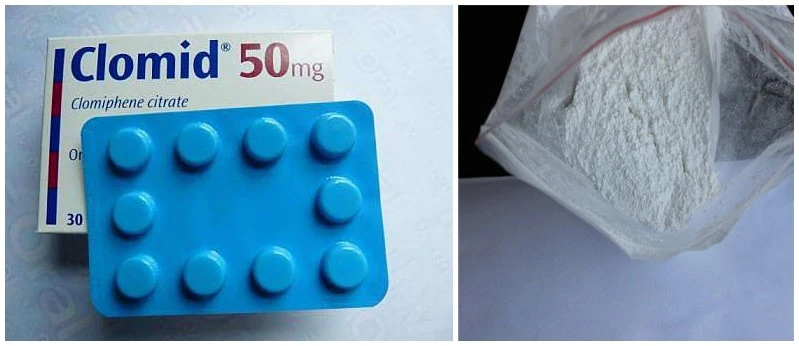
White to Off-White Cyrstalline Powder |
Any needs, please contact us
Email: Jasonraws106@gmail.com
WhatsApp: +86-15572565525
Telegram: +86-19128233885
What exactly does Clomid do?
Clomid, also known as clomiphene citrate, is a medication classified as a selective estrogen receptor modulator (SERM). It is primarily used in the field of reproductive medicine to stimulate ovulation in women who have difficulty conceiving due to anovulation or irregular ovulation. Here is a detailed explanation of how Clomid works:
Mechanism of Action: Clomid acts on the hypothalamus, which is a part of the brain that plays a crucial role in regulating the menstrual cycle. It binds to estrogen receptors in the hypothalamus and blocks their normal interaction with endogenous estrogen.
Estrogen Blockade: By blocking estrogen receptors in the hypothalamus, Clomid prevents the negative feedback effect of estrogen on the release of follicle-stimulating hormone (FSH) and luteinizing hormone (LH) from the pituitary gland.
Increased FSH and LH Release: In response to the estrogen blockade, the hypothalamus perceives lower estrogen levels, which triggers an increase in the production and release of FSH and LH from the pituitary gland.
Follicle Development and Ovulation: The increased levels of FSH stimulate the growth and development of ovarian follicles, which contain the eggs. As the follicles mature, they produce more estrogen. The increased LH levels trigger the final maturation of the dominant follicle and the release of the egg from the ovary, which is known as ovulation.
Regular Ovulation and Menstrual Cycle: By stimulating ovulation, Clomid helps women with anovulation or irregular ovulation to establish regular menstrual cycles and increase their chances of conceiving.
It is important to note that Clomid is typically prescribed for a specific duration and at specific doses determined by a healthcare professional. Regular monitoring through blood tests, ultrasound scans, and tracking of menstrual cycles is crucial to assess the response to treatment and adjust the dosage if needed.
Clomid should only be taken under the supervision of a qualified healthcare professional experienced in reproductive medicine. They can provide personalized guidance, monitor the treatment response, and manage any potential side effects.
Hot Tags: clomiphene citrate, China clomiphene citrate manufacturers, suppliers, factory, Clomiphene Citrate, Clostebol Acetate, Nandrolone Decanoate, Parabolan Regulates androgens, Testosterone Decanoate Aids Physical Growth, Testosterone Enanthate for Muscle Growth

