

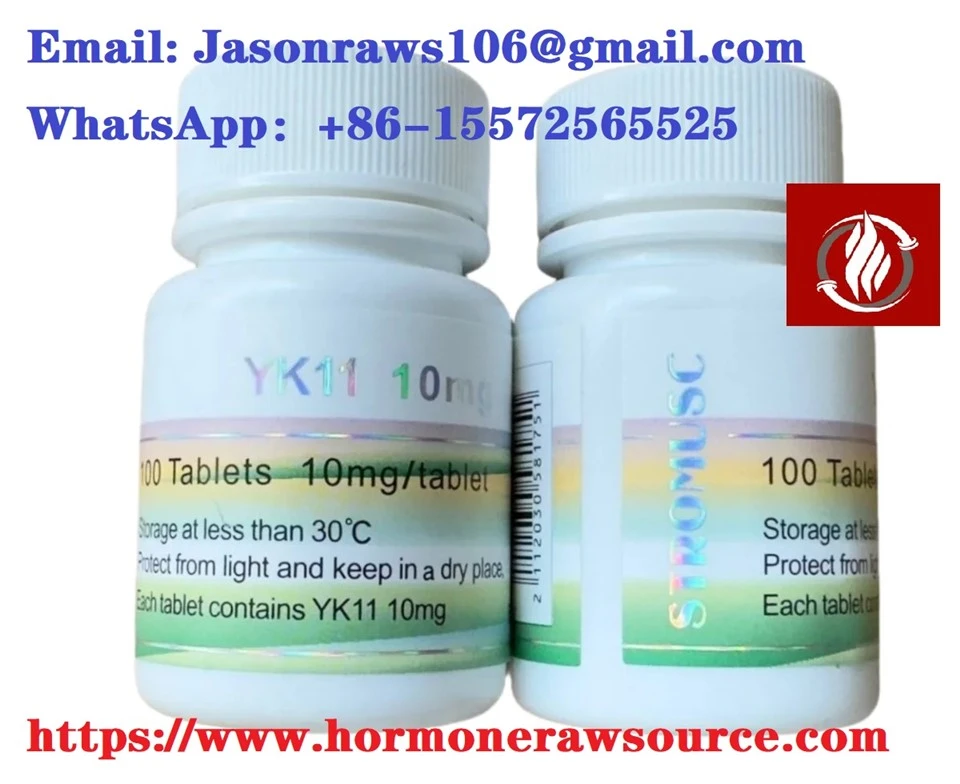
High-Quality STROMUSC YK11 10mg For Bodybuilding CAS:1370003-76-1
YK11 occupies a strange and often misunderstood corner of the performance-enhancing compound landscape. Sold alongside familiar names like ostarine and RAD-140, it is frequently lumped into the broader category of selective androgen receptor modulators (SARMs). Yet structurally, YK11 is something entirely different—a synthetic steroidal compound derived from dihydrotestosterone (DHT) that happens to possess gene-selective activity at the androgen receptor. This distinction matters. Unlike the non-steroidal SARMs that dominate the grey market, YK11 carries a steroidal backbone, 17-alpha alkylation for oral bioavailability, and a mechanism of action that no other commercially available SARM-class compound can replicate: direct upregulation of follistatin, the body's natural inhibitor of myostatin. For bodybuilders who have exhausted the returns from conventional compounds, YK11 represents a different pathway entirely—one that targets not just androgen receptor activation but the biological brakes that limit how much muscle the body will allow itself to build. This analysis examines top-quality YK11 10mg tablets from every angle relevant to the physique-focused user: chemical identity, mechanism, practical applications, expected benefits, dosing protocols, cycle design, pharmacokinetics, and the mandatory post-cycle therapy that accompanies any responsible use of this compound.
What YK11 Is: Chemistry and Classification
YK11 (CAS 1370003-76-1) is a synthetic steroidal compound with the molecular formula C₂₅H₃₄O₆ and a molecular weight of approximately 430.54 g/mol. Its chemical name-(17α,20E)-17,20-[(1-methoxyethylidene)bis(oxy)]-3-oxo-19-norpregna-4,20-dien-21-carboxylic acid methyl ester-reveals its steroidal origins. It is structurally related to DHT, which places it in a fundamentally different chemical class than the non-steroidal SARMs like RAD-140 or LGD-4033.
The compound was first described by Kanno et al. in 2011, identified in cell-based assays as a molecule that selectively activates androgen-responsive gene transcription while simultaneously inducing follistatin expression. This dual action is what sets YK11 apart. It is not a full androgen receptor agonist like traditional anabolic steroids; rather, it is a partial agonist that does not induce the N/C terminal interaction required for full transcriptional activation. This partial agonism is gene-selective, meaning YK11's activation of the androgen receptor varies depending on the target gene-a property that may contribute to a more favorable anabolic-to-androgenic ratio compared to full agonists.
The 17-alpha alkylation of YK11's steroidal structure provides oral bioavailability without requiring injection, but this modification also subjects the compound to hepatic first-pass metabolism. This is the same chemical modification found in many oral anabolic steroids, and it carries the same implication: liver stress is a legitimate concern that must be managed.
Crucially, the research base for YK11 is extraordinarily limited. All published data comes exclusively from in vitro (cell culture) studies. There are no animal studies, no pharmacokinetic studies in living organisms, and no human clinical trials. Everything reported about YK11's effects in humans-its half-life, optimal dosing, side effect profile-is derived from structural analogy to related compounds, theoretical pharmacology, and anecdotal user reports. This is not a compound with a robust scientific foundation; it is an investigational research chemical being used off-label by athletes.


Core Features and Mechanism of Action
YK11 operates through two distinct but complementary pathways.
Pathway One: Partial Androgen Receptor Agonism
Upon binding to the androgen receptor in muscle cells, YK11 triggers translocation of the receptor to the nucleus. There, it influences the transcription of target genes, leading to the upregulation of key myogenic regulatory factors including MyoD, Myf5, and myogenin. Studies have shown that YK11 induces the expression of these factors more significantly than DHT itself. However, because YK11 is a partial rather than full agonist, its androgenic side effects-such as hair loss, acne, and prostate stimulation-may be milder per milligram than full agonists like DHT or traditional anabolic steroids.
Pathway Two: Follistatin Induction and Myostatin Inhibition
This is the feature that makes YK11 genuinely unique. YK11 significantly increases the expression of follistatin (Fst), a glycoprotein that binds to and inhibits myostatin. Myostatin (GDF-8) is a member of the TGF-beta superfamily that acts as a potent negative regulator of skeletal muscle mass-it is the biological mechanism that tells the body when to stop growing muscle. By upregulating follistatin, YK11 effectively removes this brake on muscle development.
This follistatin induction is androgen receptor-dependent-it was blocked by an androgen receptor antagonist in the original Kanno et al. study-and it is a response that is absent with DHT alone. The anabolic effects of YK11 have been shown to be largely mediated by this follistatin induction; when an anti-follistatin antibody was introduced, the effects were reversed.
This dual mechanism-partial AR agonism plus myostatin inhibition via follistatin upregulation-is hypothesized to confer anabolic effects that neither pathway could achieve alone. YK11 is the only SARM-class compound with a demonstrated in vitro capacity to inhibit myostatin through direct follistatin induction.
Applications in Bodybuilding
YK11 serves a narrow but valuable role in physique development. It is not a mass-builder in the style of LGD-4033, nor is it primarily a strength compound like RAD-140. Rather, YK11 is a recomp and hardening tool, often deployed in the back half of a SARM stack or added to a low-dose testosterone base as a "dry oral" alternative to compounds like masteron.
The compound is commonly used for:
Aesthetic Lean Tissue Gains: Over a 6-8 week window at 10 mg/day, realistic returns are approximately 3-6 pounds of lean tissue with a visibly tighter, drier look-not the 15-pound scale jumps associated with wetter bulking compounds. The myostatin inhibition pathway may support muscle cell hyperplasia (the creation of new muscle cells) rather than simply hypertrophy (the enlargement of existing cells), which is a qualitatively different type of growth.
Contest Preparation and Hardening: YK11 shows up in contest-prep finishers and hardening stacks because it produces dry, aesthetic results without the water retention associated with many other compounds. The steroidal DHT-derivative structure contributes to a hard, dense look that bodybuilders value in the final weeks before a show.
Recomposition: For users at or near their genetic ceiling, YK11 offers a mechanism-myostatin inhibition-that can theoretically allow for additional lean tissue accrual even when conventional pathways have been exhausted. Some experienced users describe it as a compound that "takes off the limits" on the body's genetic muscle-building potential.
Stacking: YK11 is frequently stacked with other SARMs. Common combinations include YK11 with RAD-140 (for synergy in hardness and aggression) or YK11 with LGD-4033 (to add a myostatin-inhibiting layer to a mass-gaining cycle). It can also be layered over a testosterone base as an oral finisher.
Benefits: What Users Report
The benefits attributed to YK11 in anecdotal reports include:
Myostatin Suppression: This is the headline benefit and the reason YK11 exists as a distinct compound. By inhibiting the primary deterrent to continuous muscle growth, YK11 may allow for muscle gains that would otherwise be impossible once genetic limits are approached.
Muscle Hardening and Density: Users consistently report a harder, more dense muscle appearance. This is likely a function of the DHT-derivative structure, which promotes a dry, aesthetic look with minimal water retention.
Increased Pumps and Fullness: Better pumps and increased muscular fullness are commonly reported, likely reflecting enhanced nutrient delivery and glycogen retention in muscle tissue.
Strength Enhancement: While not primarily a strength compound, YK11 does increase overall physical performance and strength.
Minimal Estrogenic Side Effects: Because YK11 does not aromatize to estrogen, users do not experience the water retention or gynecomastia risk associated with aromatizing compounds.
Dosage Protocol for 10mg Tablets
Dosing YK11 requires understanding that the compound's effects are dose-dependent but that higher doses carry proportionally greater risks. The estimated half-life of 6-10 hours necessitates twice-daily dosing to maintain stable plasma concentrations.
Beginner Dose: 5-7.5 mg per day, split into two equal doses (morning and evening). This allows the user to assess tolerance and response before considering dose escalation.
Intermediate Dose: 8-10 mg per day, typically administered as 5 mg in the morning and 5 mg in the evening. This is the most common protocol for users with prior SARM experience.
Advanced Dose: 10-15 mg per day, split into two or even three doses throughout the day. Some experienced users report running up to 20-30 mg daily, though this carries significantly increased risk.
Administration with 10mg Tablets: For a 10mg tablet, the most straightforward approach is to split the tablet in half and take 5mg in the morning and 5mg in the evening. Some users take the full 10mg as a single daily dose, but this is less optimal given the short half-life. The compound reaches peak concentration approximately 1.5 hours after oral administration.
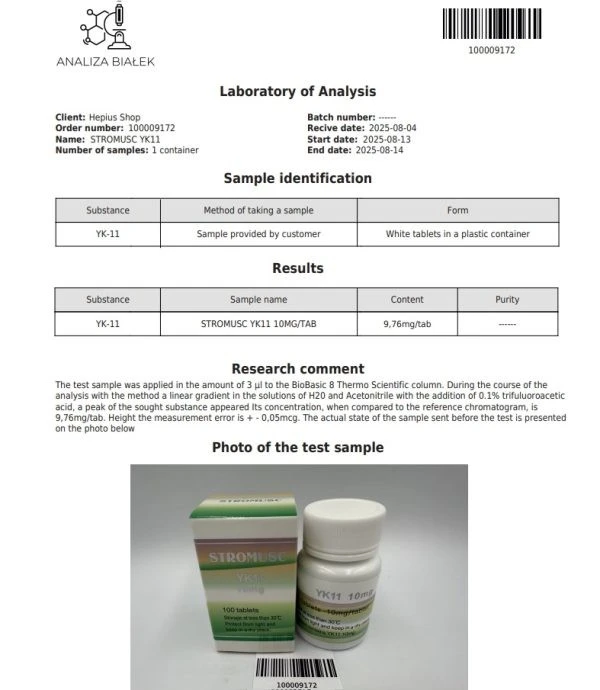
Tablet Quality Considerations: YK11 is the most frequently mislabeled compound on the grey market because steroidal synthesis is expensive. Third-party certificate of analysis (COA) testing from the vendor is non-negotiable. Without verified quality, dosage recommendations are meaningless.
Cycle Design
YK11 cycles typically run 6-8 weeks. Extended cycles beyond 8 weeks are not recommended due to the compound's steroidal nature, suppression of endogenous hormone production, and potential for liver stress.
Standalone Cycle (6-8 weeks):
●Weeks 1-8: YK11 5-10 mg/day, split AM/PM
●Begin at lower end of dose range and titrate up based on tolerance
●Liver support (TUDCA 500 mg/day) recommended throughout
●Monitor blood pressure, which can be elevated
Stacked Cycle with RAD-140 (8 weeks):
●Weeks 1-8: RAD-140 10-20 mg/day (single dose, longer half-life)
●Weeks 1-8: YK11 5-10 mg/day, split AM/PM
●This combination synergizes hardness and aggression
Stacked Cycle with LGD-4033 (8 weeks):
●Weeks 1-8: LGD-4033 10 mg/day
●Weeks 1-8: YK11 5 mg/day, split AM/PM
●Adds myostatin inhibition to a mass-gaining base
Testosterone Base: Many experienced users recommend running YK11 with a low-dose testosterone base (e.g., 100-200 mg/week) to maintain endogenous function and mitigate suppression. This is particularly relevant given YK11's steroidal nature and profound suppressive effects.
Washout Period: After the final dose, allow approximately 2-3 half-lives (roughly 24-36 hours) before beginning PCT.
Half-Life and Pharmacokinetics
The estimated half-life of YK11 is approximately 6-10 hours. This estimate is based on structural analogy rather than formal pharmacokinetic studies-no measured elimination half-life for YK11 exists in any species. The compound's actual bioavailability, distribution, metabolism, and elimination profile in living systems remain unknown.
The practical implications of this estimated half-life are clear:
Twice-Daily Dosing: To maintain stable plasma levels, YK11 should be dosed twice daily, approximately 10-12 hours apart. A morning dose and an evening dose provide coverage throughout the day and night.
Peak Concentration: Time to peak concentration is estimated at approximately 1.5 hours after oral administration.
Active Duration: The active duration is approximately 10 hours, consistent with the estimated half-life.
Metabolism: In vivo studies have demonstrated that YK11 undergoes extensive metabolism. The parent compound is typically not detected in urine samples. Metabolism involves both Phase I and Phase II reactions, leading to unconjugated, glucuronidated, and sulfated metabolites. While unconjugated metabolites disappear within 24 hours post-administration, both glucuronidated and sulfated metabolites are traceable for more than 48 hours.
Blood-Brain Barrier: Physiologically based pharmacokinetic modeling has suggested that YK11 has high permeability across the blood-brain barrier. This is significant given emerging research on potential neurological effects.
Post-Cycle Therapy (PCT)
YK11 is a steroidal compound that suppresses endogenous hormone production. PCT is mandatory after any cycle lasting 4 weeks or longer. This is not optional-it is a non-negotiable component of responsible use.
Why PCT Is Required: YK11 suppresses the hypothalamic-pituitary-gonadal (HPG) axis, reducing luteinizing hormone (LH) and follicle-stimulating hormone (FSH) production, which in turn suppresses endogenous testosterone production. Recovery of the HPG axis can take several weeks to months. Failure to implement PCT can result in prolonged hypogonadism, with all its associated consequences.
Standard PCT Protocol (4 weeks):
●Weeks 1-4: Nolvadex (tamoxifen citrate) 20/20/10/10 mg per day
●Alternative: Enclomiphene 12.5 mg per day for 4 weeks
Alternative PCT Protocol:
●Weeks 1-2: Clomid 50 mg/day
●Weeks 3-4: Clomid 25 mg/day
Supportive Measures During PCT:
●Continue liver support (TUDCA) during PCT
●Monitor lipid panels-HDL drop and LDL rise are common with YK11
●Consider DHEA supplementation (100 mg/day) as YK11 has been noted to depress estradiol levels
Monitoring Recovery: Bloodwork is the only reliable way to confirm hormonal recovery. Test total testosterone, free testosterone, estradiol (E2), LH, FSH, and prolactin before, during, and after PCT. If LH and FSH recover but testosterone remains low, this may indicate direct testicular toxicity requiring further evaluation.
Duration of Recovery: The duration of recovery varies depending on dosage, cycle length, and individual physiology. Some users recover within weeks; others may require months. Post-PCT bloodwork is essential to confirm restoration of the HPG axis.
Risk Profile and Side Effects
YK11 carries a risk profile that is more aligned with oral anabolic steroids than with non-steroidal SARMs.
Hepatotoxicity: The 17-alpha alkylation that provides oral bioavailability also subjects YK11 to hepatic first-pass metabolism with associated risk of liver stress. Case reports have documented liver enzyme elevation and cholestatic jaundice in YK11 users. One reported case involved jaundice, scleral icterus, decreased appetite, and pruritis with ALT 148 IU/L and AST 88 IU/L after three months of use. Liver support (TUDCA 500 mg/day) is advised.
Neurotoxicity: Rodent studies have shown that YK11 induces oxidative stress and mitochondrial dysfunction in the hippocampus. The administration of YK11 resulted in alterations in the endogenous antioxidant system, promoting increased oxidative stress and proteotoxic effects. This suggests that YK11 may pose potential neurological risks. These findings are from rodent models and may not directly translate to humans, but they are cause for concern.
Clinical Data
|
Brand |
STROMUSC |
|
Trade names |
YK11; (17α,20E)-17,20-diene-21-carboxylic acid methyl ester |
|
CAS |
1370003-76-1 |
|
Molar mass |
430.541 |
|
Formula |
C25H34O6 |
|
Purity |
Above 98% |
|
Apprarance |
10mg*100 |
Any needs, please contact us
Email: Jasonraws106@gmail.com
WhatsApp: +86-15572565525
Telegram: +86-15871669785


Conclusion: A Compound for the Informed and Experienced
YK11 is not a beginner's compound. It is not a compound to be taken lightly. It is a steroidal SARM hybrid with a unique dual mechanism that offers genuine benefits-myostatin inhibition through follistatin upregulation-but carries risks that are more aligned with oral anabolic steroids than with non-steroidal SARMs.
For the experienced user who understands the risks, has access to verified product quality, implements proper liver support, executes a responsible PCT protocol, and monitors bloodwork throughout, YK11 can deliver 3-6 pounds of lean, hard, aesthetic tissue over a 6-8 week cycle. It is a recomp and hardening tool, not a mass-builder, and it serves best as a finisher or stack component rather than a standalone bulking agent.
Hot Tags: high-quality stromusc yk11 10mg for bodybuilding cas:1370003-76-1, China high-quality stromusc yk11 10mg for bodybuilding cas:1370003-76-1 manufacturers, suppliers, factory, AC 262 Selective androgen receptor modulator, GW0742 Hormone and Metabolic Regulators, LGD4033, MK677 growth hormone secretion, RAD140, RAD140 increase lean muscle mass

