

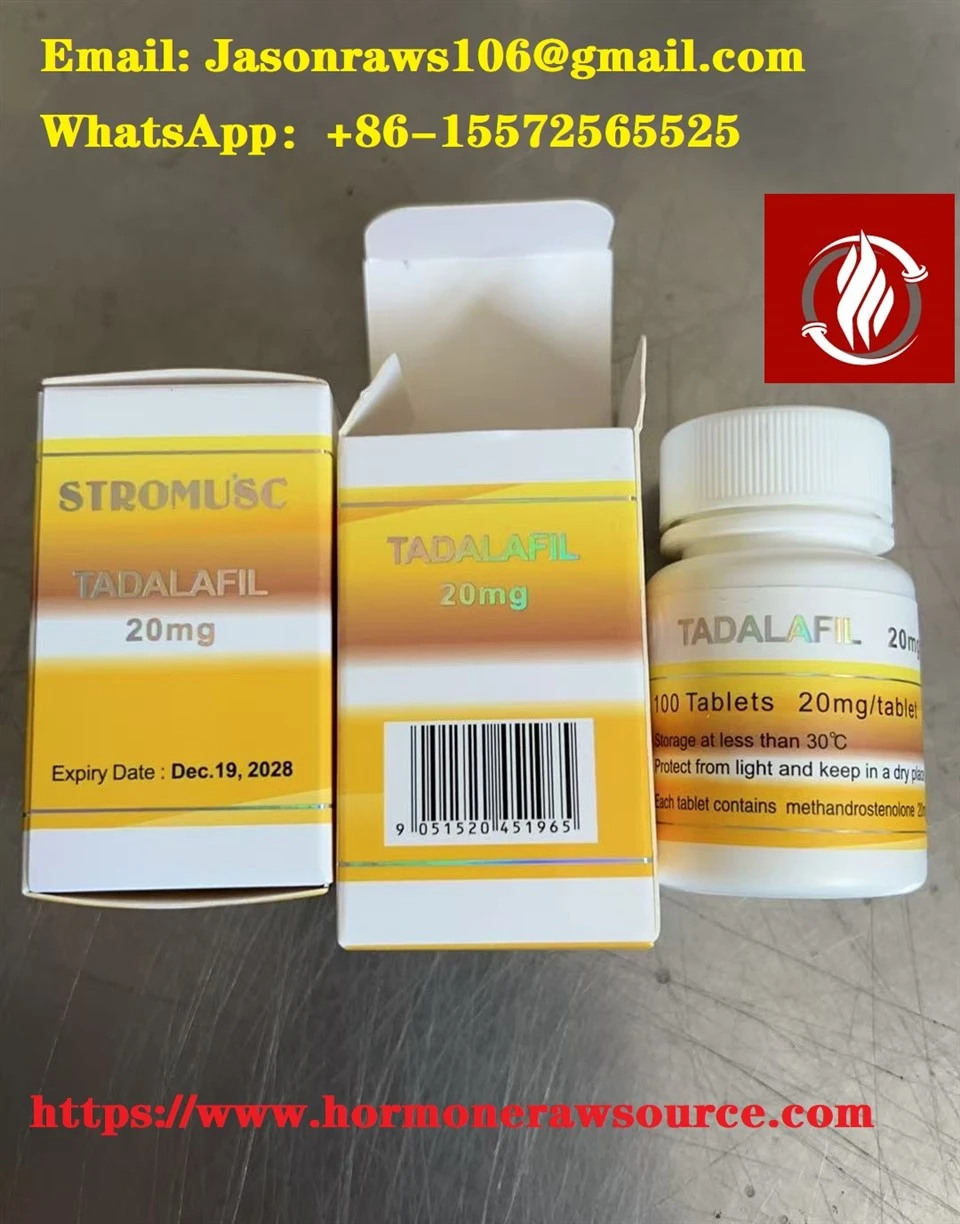
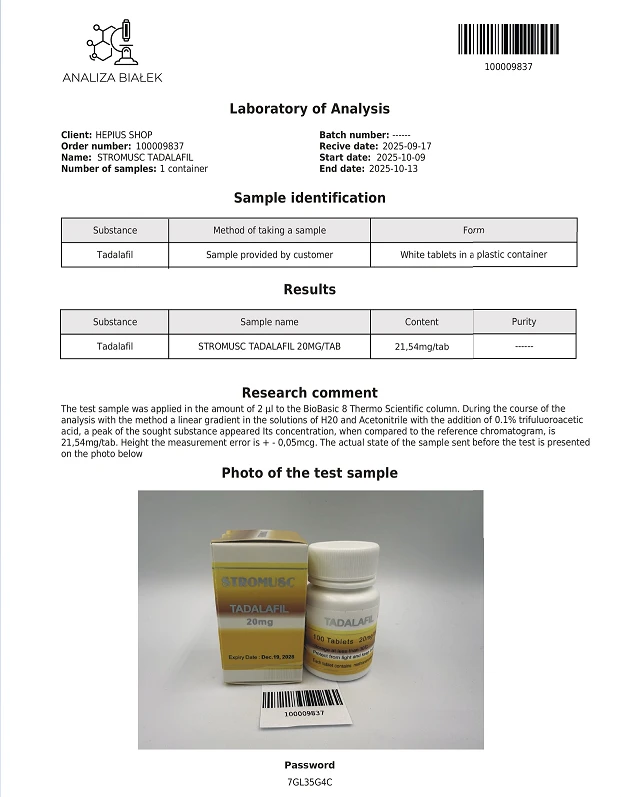
Premium Brand STROMUSC Cialis(Tadalafil)20mg For Sexual Enhancement CAS:171596-29-5
The arrival of phosphodiesterase type 5 (PDE5) inhibitors reshaped the clinical management of erectile dysfunction (ED), but not all agents within this class share the same therapeutic philosophy. Sildenafil, the molecule that inaugurated the era, demanded a kind of temporal obedience: a tablet swallowed on a relatively empty stomach, followed by a wait of roughly an hour, with a narrow window of opportunity that often closed before the evening had fully unfolded. Premium brand Cialis, containing tadalafil, was conceived around a different premise. At the 20 mg on-demand dose, it does not merely facilitate an erection; it restores a measure of temporal autonomy to a sexual encounter, decoupling the act from the clock in a way that no other oral ED therapy had previously achieved. Understanding why this is so requires looking beyond the marketing language and into the pharmacokinetic architecture of the molecule itself.
What It Is: A Selective, Long-Residing PDE5 Inhibitor
Tadalafil is a selective inhibitor of cyclic guanosine monophosphate (cGMP)-specific phosphodiesterase type 5. Its empirical formula is C₂₂H₁₉N₃O₄, and it is presented as a crystalline solid that is practically insoluble in water. The 20 mg formulation is the highest strength approved for on-demand use in most markets, supplied as a film-coated, almond-shaped tablet in the distinctive yellow hue associated with the brand. What separates tadalafil from its predecessors at the molecular level is not simply its potency against PDE5-it is indeed over 10,000-fold more selective for PDE5 than for PDE1, PDE2, PDE4, and PDE7-but the duration of its residence within the body. That duration is the pharmacologic foundation upon which the entire clinical character of the 20 mg dose is built.

The Biochemical Logic of the Long Window
Penile erection during sexual stimulation depends on the release of nitric oxide from nerve terminals and endothelial cells, which in turn stimulates the synthesis of cGMP in cavernosal smooth muscle. cGMP causes smooth muscle relaxation and increased blood flow into the corpus cavernosum; PDE5 is the enzyme responsible for degrading cGMP and thereby terminating this signal. Tadalafil inhibits PDE5, allowing cGMP to accumulate. Crucially, because sexual stimulation is required to initiate the local release of nitric oxide, the drug has no effect in the absence of stimulation. This mechanistic dependence on the natural trigger is what makes the prolonged presence of tadalafil in the plasma pharmacologically meaningful rather than merely a matter of convenience: the molecule waits, silently, for the physiological cue that allows it to act.
That waiting period is unusually generous. The mean terminal half-life of tadalafil is approximately 17.5 hours in healthy subjects, with a mean oral clearance of 2.5 L/hr. Peak plasma concentrations are reached at a median of two hours after ingestion, though the range extends from thirty minutes to six hours, and the rate and extent of absorption are not influenced by food. The apparent volume of distribution is roughly 63 liters, and at therapeutic concentrations 94% of the drug in plasma is bound to proteins. Metabolism proceeds predominantly through CYP3A4, yielding a catechol metabolite that is further methylated and glucuronidated; the major circulating metabolite, methylcatechol glucuronide, is not expected to contribute meaningfully to pharmacological activity at observed concentrations. Excretion occurs mainly as metabolites in the feces and, to a lesser extent, in the urine. The practical consequence of this elimination profile is that a single 20 mg tablet produces a therapeutic presence that outlasts the ordinary rhythms of an evening and extends well into the following day.
Application and the Meaning of "On-Demand" at 20 mg
The 20 mg dose is not the starting dose for most patients; regulatory guidance recommends beginning at 10 mg and titrating upward to 20 mg based on efficacy and tolerability. Once the 20 mg level is reached, however, the dosing logic is distinctly different from that of shorter-acting agents. The maximum recommended dosing frequency is once per day, and the label explicitly states that Cialis for use as needed improves erectile function compared with placebo up to 36 hours following dosing. Clinical pharmacodynamic work has detected an erectogenic response as early as sixteen minutes after a single 20 mg dose, and responsiveness has been documented at both 24 and 36 hours post-dose. The European regulatory assessment describes a window of opportunity beginning at thirty minutes and extending to twelve hours as the conservatively labeled period, while acknowledging that trial evidence supports efficacy beyond that point.
This temporal expanse is not a marginal refinement; it changes the behavioral texture of treatment. A man who takes a 20 mg tablet on Friday evening is not committing to a single, narrowly timed encounter. He remains, in a pharmacological sense, available to the possibility of intimacy through Saturday and into Sunday. Survey data comparing PDE5 inhibitors illustrate the experiential gap: the mean interval between drug intake and intercourse has been reported as 18.6 to 21.4 hours for tadalafil, against 3.6 to 6.6 hours for sildenafil. The longer interval is not a failure of planning; it is the point. It reflects a shift from a model in which the drug is a prelude to a scheduled event toward one in which the drug recedes into the background of daily life.
Benefits Beyond the Erectile Response
The most visible benefit of the 20 mg on-demand formulation is the restoration of spontaneity, but the clinical advantages extend further. The absence of a food effect means that a meal-including one that might ordinarily interfere with the absorption of a shorter-acting PDE5 inhibitor-does not become an obstacle to treatment. The prolonged plasma residence also means that the patient is not required to predict the exact hour of sexual activity with any precision. For couples whose intimacy does not follow a predictable schedule, this reduction in anticipatory planning can alleviate a subtle but corrosive form of performance pressure: the sense that the drug itself has become a third participant, dictating when closeness may occur.
The efficacy data at 20 mg are substantial. In the two primary US trials, the 20 mg dose produced statistically significant and clinically meaningful improvements across all three primary efficacy variables-the erectile function domain score and the per-patient percentages of successful insertion and successful maintenance of erection-and the treatment effect did not diminish over time. In the European regulatory analysis, 58.6% of patients receiving 20 mg tadalafil improved to the "no-ED" category at endpoint, compared with 39.7% of those on 10 mg and 10.9% of those on placebo. These figures do not merely describe a better erection; they describe a meaningful proportion of men crossing the threshold back into normal erectile function.
Safety, Tolerability, and the Boundaries of Use
No discussion of a 20 mg PDE5 inhibitor would be honest without acknowledging the adverse-event profile. In placebo-controlled trials, the most common reactions at the 20 mg dose were headache (15%), dyspepsia (10%), back pain (6%), myalgia (3%), nasal congestion (3%), flushing (3%), and limb pain (3%). These events are generally mild to moderate and tend to attenuate with continued treatment, but the myalgia and back pain signal is somewhat more characteristic of tadalafil than of other agents in the class and should be mentioned to patients so that it is not misinterpreted as an unrelated musculoskeletal problem.
The absolute contraindication that governs all PDE5 inhibitor prescribing applies with equal force here: any use of organic nitrates, whether regular or intermittent, is prohibited because of the risk of profound hypotension. Potent CYP3A4 inhibitors such as ketoconazole or ritonavir substantially increase tadalafil exposure and require dose adjustment or avoidance. The label also warns of non-arteritic anterior ischemic optic neuropathy and sudden hearing decrease, events that are rare but warrant immediate discontinuation and medical evaluation should they occur. Renal function matters: for creatinine clearance between 30 and 50 mL/min, a starting dose of 5 mg is recommended with a maximum of 10 mg not more than once every 48 hours, and for clearance below 30 mL/min or hemodialysis, the maximum is 5 mg not more than once every 72 hours. These constraints do not undermine the utility of the 20 mg dose; they define the population in which its benefits can be pursued safely.
Dosage Architecture and the Question of "Cycle"
The notion of a "cycle" does not map neatly onto on-demand tadalafil, and this is a conceptual point worth clarifying rather than glossing over. The 20 mg tablet is not taken on a fixed schedule; it is taken when the patient anticipates a reasonable probability of sexual activity within the ensuing day or so, with the understanding that the pharmacological window will remain open far longer than the encounter itself may require. The maximum frequency is one dose per day. For patients whose sexual activity is reliably predictable and infrequent-NHS guidance describes on-demand tadalafil as suitable for individuals who anticipate sexual activity up to twice weekly-this intermittent strategy is well matched to the pharmacokinetics. For those whose activity is more frequent, a low-dose daily regimen (2.5 or 5 mg) is the alternative, but that is a different therapeutic model with a different steady-state profile, and it should not be conflated with the 20 mg on-demand approach. The "cycle," in other words, is not a calendar of pills but the periodic opening and gradual closing of a therapeutic window, each opening initiated by a single tablet and sustained by the molecule's slow elimination.
Clinical Data
| Brand | STROMUSC |
|
Trade names |
Cialis, Cidala, Adcirca,Tadalafil |
|
CAS |
171596-29-5 |
|
Molar mass |
389.41 |
|
Formula |
C22H19N3O4 |
|
Purity |
Above 98% |
|
Apprarance |
20mg*100 |
Any needs, please contact us
Email: Jasonraws106@gmail.com
WhatsApp: +86-15572565525
Telegram: +86-15871669785


Conclusion: A Molecule That Gives Back the Clock
Premium brand Cialis 20 mg is often reduced to a single selling point-the "weekend pill"-but that phrase, however memorable, understates what the pharmacology actually accomplishes. The 17.5-hour half-life and the documented responsiveness extending to 36 hours are not merely conveniences; they represent a reconfiguration of the relationship between treatment and intimacy. The drug is taken, and then it steps back. It does not require an empty stomach, it does not demand a precisely timed encounter, and it does not expire before the evening has had a chance to become something else. For the man whose ED has made sex feel like a logistical exercise, that reconfiguration can be as therapeutically significant as the erectile response itself. The 20 mg dose is not the right starting point for every patient, and it is not without its headaches-sometimes quite literally-but within the appropriate clinical context, it remains one of the most distinctive achievements in the pharmacological management of sexual dysfunction: a molecule that treats not only the vasculature, but the tyranny of the clock.
Hot Tags: premium brand stromusc cialis(tadalafil)20mg for sexual enhancement cas:171596-29-5, China premium brand stromusc cialis(tadalafil)20mg for sexual enhancement cas:171596-29-5 manufacturers, suppliers, factory

