

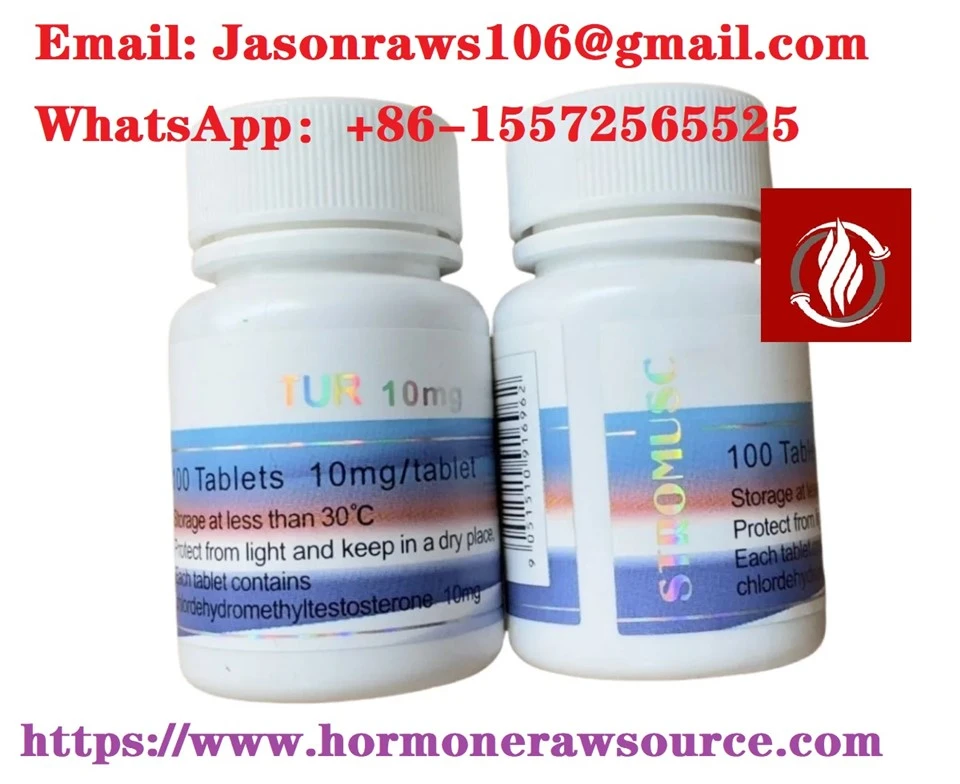
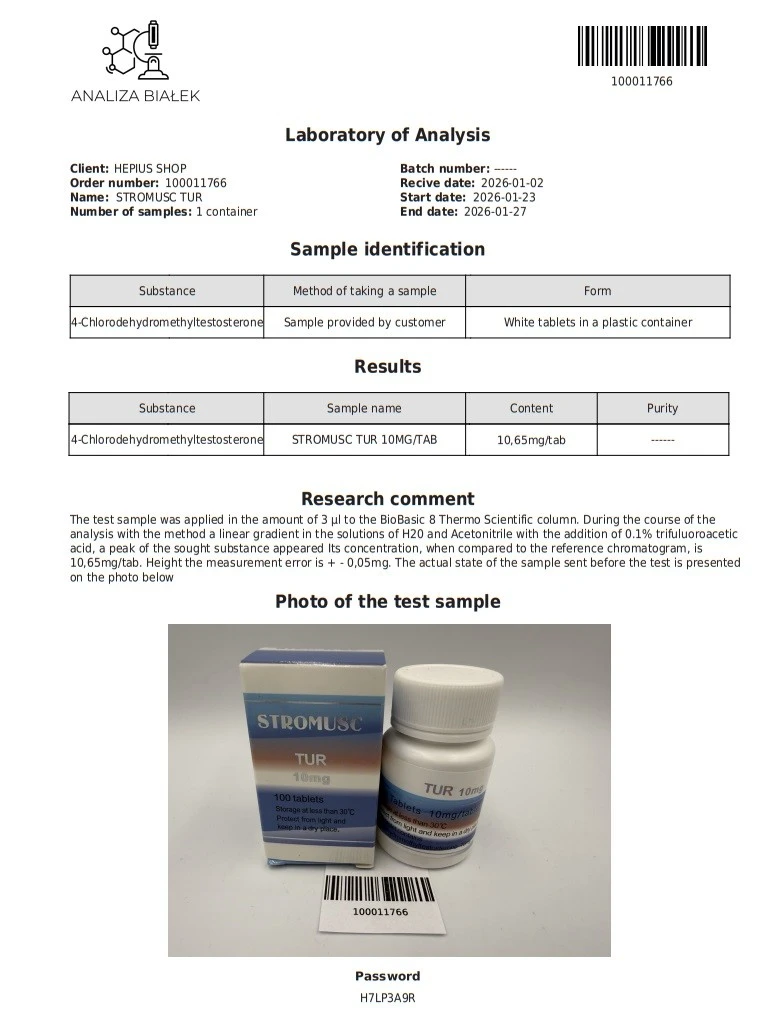
Premium Brand STROMUSC Turinabol(Chlorodehydromethyltestosterone)10mg For Bodybuilding CAS:10418-03-8
Most profiles of Turinabol begin with the same line: “Dianabol without the bloat.” That shorthand is chemically accurate but analytically lazy. The 4-chloro substitution that defines chlorodehydromethyltestosterone does far more than remove water—it rewires the compound’s relationship with estrogen, with SHBG, and with the subjective texture of a cycle. Understanding Turinabol on its own terms, rather than as a Dianabol derivative with a defect corrected, is the difference between using it well and using it blindly.
Chemical identity and historical baggage
Turinabol is 4-chlorodehydromethyltestosterone, a 17α-alkylated oral anabolic steroid developed at the Jenapharm facility in East Germany during the 1960s. It was not designed for bodybuilding. It was designed for a state doping apparatus, and the archival record is unambiguous: Oral-Turinabol was administered to thousands of athletes, often without their knowledge, from the late 1960s through the fall of the GDR. That history matters for two reasons. First, it produced an unusually large real-world dataset of human exposure decades before the compound entered gym folklore. Second, it explains why Turinabol's metabolite detection window became a forensic problem: the same long-term metabolites that eluded 1970s testing regimes resurfaced in retests of the 2008 and 2012 Olympic Games.


The 4-chloro substitution: what it actually does
Turinabol is structurally a hybrid of methandrostenolone (Dianabol) and clostebol (4-chlorotestosterone). Three features govern its behavior. The 1,2-double bond reduces affinity for 5α-reductase, blunting conversion to a more androgenic metabolite. The 4-chloro group blocks the aromatase enzyme from converting the compound to estrogen. And the 17α-methyl group allows the molecule to survive first-pass hepatic metabolism, making oral administration viable.
The practical consequence of zero aromatization is not merely "no gyno and no bloat." It is a fundamentally different anabolic signal. Dianabol's mass-building reputation owes a great deal to estrogen-estrogen sensitizes muscle to androgen-driven growth, promotes glycogen storage, and contributes to the "wet" fullness that users associate with size. Turinabol has no access to that lever. Its published anabolic-to-androgenic ratio is roughly 54:6 against testosterone's 100:100, a strongly dissociated profile that favors muscle over masculinizing effects, but one that also caps the absolute scale-weight ceiling. What Turinabol builds, it builds without the estrogenic amplification-and without the estrogenic baggage.
SHBG and the "force multiplier" effect
The most underappreciated aspect of Turinabol is its affinity for sex hormone-binding globulin. SHBG sequesters testosterone in circulation, rendering it biologically inert. Turinabol competes for SHBG binding, displacing testosterone and raising the free, bioavailable fraction. This is not a trivial pharmacokinetic footnote. It means that Turinabol functions as an amplifier of whatever androgen is already present. In a stack with a testosterone base, this produces a free-testosterone rise disproportionate to the total testosterone level, which is why experienced users often describe Turinabol as making a modest dose of injectable testosterone "feel" larger than the milligram count suggests.
That same mechanism explains a recurring complaint in solo Turinabol cycles. Because the compound suppresses endogenous testosterone production through negative feedback at the hypothalamus and pituitary while simultaneously lowering SHBG, the ratio of free to total testosterone can remain deceptively favorable even as total production collapses. Users may feel functional-strength holds, libido does not crater immediately-while their endogenous axis is substantially suppressed. The absence of estrogenic side effects is not evidence of endocrine safety.
Dosage, cycle structure, and the 10 mg tablet
The 10 mg tablet is the standard unit for Turinabol, and it lends itself to graded dosing. The compound's half-life is approximately 16 hours, longer than most oral steroids, which supports twice-daily administration for stable blood levels. A 20 mg daily dose is typically split 10 mg in the morning and 10 mg in the afternoon; a 40 mg dose is often divided 20 mg/10 mg/10 mg across the day to smooth peaks and reduce gastrointestinal discomfort.
Dosing falls into three practical tiers. Beginner male users generally start at 20–30 mg daily for six weeks-the lowest tier at which meaningful strength and lean tissue accrual are reported, and the easiest from which to recover. Intermediate users occupy the 40–50 mg range over six to eight weeks; this is the most commonly discussed bodybuilding dose and the point at which SHBG suppression, strength gains, and dry vascularity become pronounced. Advanced users may push to 60–80 mg, but the returns diminish sharply while hepatic and lipid stress do not. For female users, the calculus is different and the margin is narrower: virilization has been reported at doses as low as 5 mg daily, and 2.5–5 mg daily is the only defensible entry point, with immediate cessation at the first sign of voice change or clitoral sensitivity.
Turinabol can be run as a solo oral cycle or as a kickstart to an injectable testosterone cycle. The solo route is simpler but more suppressive than its reputation suggests. The stacked route-40–60 mg Turinabol daily alongside 300–500 mg testosterone weekly-uses the oral's SHBG-lowering effect to amplify the injectable's free fraction during the weeks before the ester saturates. Stacking Turinabol with another oral, such as Anavar or Winstrol, compounds hepatic stress without a proportionate payoff and is generally a poor allocation of risk.
Half-life, clearance, and the PCT timeline
The ~16-hour half-life dictates both dosing frequency and the timing of post-cycle therapy. After the final tablet, roughly half the active compound is cleared within 16 hours, 75% within 32 hours, and the compound is effectively cleared within three to four days. Because there is no ester depot to wait for, PCT begins the day after the last Turinabol dose-not a week later, and certainly not after the two-week wait appropriate for long-ester injectables.
A SERM-based protocol is the standard. Tamoxifen at 20 mg daily for four weeks is the most commonly reported approach, beginning the day after the final tablet. Some protocols use clomiphene at 50 mg daily or enclomiphene at 12.5–25 mg daily, particularly when recovery of LH and FSH is the primary concern. The endpoint of PCT is not subjective-it is a blood panel showing restored LH, FSH, and total testosterone, typically drawn four to six weeks after PCT concludes. Turinabol's moderate suppression profile makes recovery realistic, but "realistic" is not "automatic," and a solo cycle without PCT is the most common avoidable error with this compound.
What to monitor, and what the compound will not tell you
Turinabol's side-effect profile is quiet in the ways users notice and loud in the ways they do not. Androgenic effects-acne, hair loss, aggression-are minimal for most men at moderate doses. Estrogenic effects are absent by structure. But the 17α-methyl group that enables oral bioavailability imposes a fixed hepatic cost: ALT and AST elevation is expected at doses above 30 mg daily, and HDL suppression is aggressive and cumulative across repeated cycles. The lipid hit, not the transient liver enzyme bump, is the quiet long-term liability.
Bloodwork should establish baseline liver enzymes, lipids, total and free testosterone, LH, FSH, and SHBG before the cycle; repeat at week four; and repeat again after PCT. TUDCA at 500–1000 mg daily and NAC at 600–1200 mg daily are rational on-cycle supports, but they do not license indefinite oral use. Cycle length beyond eight weeks buys little additional tissue and adds disproportionate hepatic and lipid burden. Turinabol rewards restraint more than escalation.
Clinical Data
| Brand | STROMUSC |
|
Trade names |
4-Chlorodehydromethyltestosterone, Oral Turinabol, Dehydrochloromethyltestosterone |
|
CAS |
2446-23-3 |
|
Molar mass |
334.88 |
|
Formula |
C20H27ClO2 |
|
Purity |
Above 98% |
|
Apprarance |
10mg*100 |
Any needs, please contact us
Email: Jasonraws106@gmail.com
WhatsApp: +86-15572565525
Telegram: +86-15871669785


The bottom line
Turinabol is not a mass drug, and it is not a "mild" drug in the absolute sense. It is a precision oral: a non-aromatizing, SHBG-lowering, 17α-alkylated compound that produces dry strength and visible lean tissue without estrogenic noise, at the cost of meaningful HPTA suppression, predictable hepatic stress, and a lipid profile that demands respect. The 10 mg tablet format suits the compound's pharmacology well-graded, split, and titrated rather than front-loaded. Used with a testosterone base and recovered with a properly timed SERM protocol, it does what few orals can: add quality without adding water. Used solo and recovered casually, it exposes the gap between a compound's reputation and its physiology.
Hot Tags: premium brand stromusc turinabol(chlorodehydromethyltestosterone)10mg for bodybuilding cas:10418-03-8, China premium brand stromusc turinabol(chlorodehydromethyltestosterone)10mg for bodybuilding cas:10418-03-8 manufacturers, suppliers, factory

